Canonical architecture · v1.0 · adopted July 30, 2026

Framework

The PT is a developing multilevel, configurational liability framework. It specifies three latent domains – phenotype-specific trait profile, Cognitive Capacity, and Neurodevelopmental Burden – and proposes that their joint configuration within time-varying environmental context generates Functional and Clinical Expression. Clinical Diagnosis is a distinct downstream classification. The domains have preliminary operationalizations, making the PT a testable framework rather than only a theoretical model.

View model history
PT-FRM-001 · r1Active
The framework combines one phenotype-specific component with two broadly transdiagnostic components.

The phenotype-specific trait profile supplies the form of neurodevelopmental variation that links the model to a particular phenotype – for example, autism or ADHD – and specifies the type and magnitude of the associated traits. Cognitive Capacity and Neurodevelopmental Burden are not specific to any one diagnosis; instead, they influence how those traits affect functioning and become clinically apparent. Environmental fit further modifies these relations.

Three components

Expression, then diagnosis

The three components are theoretical constructs. Their joint configuration within current context generates Functional and Clinical Expression is a high-level, integrative concept describing what becomes observable, functionally relevant, or clinically salient when the phenotype-specific trait profile, Cognitive Capacity and its compensatory deployment, Neurodevelopmental Burden, and environment interact. It includes the expressed trait pattern and may also include context-dependent strengths and difficulties, everyday functioning, distress, compensatory effort and cost, and support need. Clinical Diagnosis is a distinct downstream classification of this expression, not part of the expression itself. Each study must specify the particular expression outcome or outcomes it measures.Read the complete record. Clinical Diagnosis is a separate downstream classification under specified criteria and ascertainment conditions.

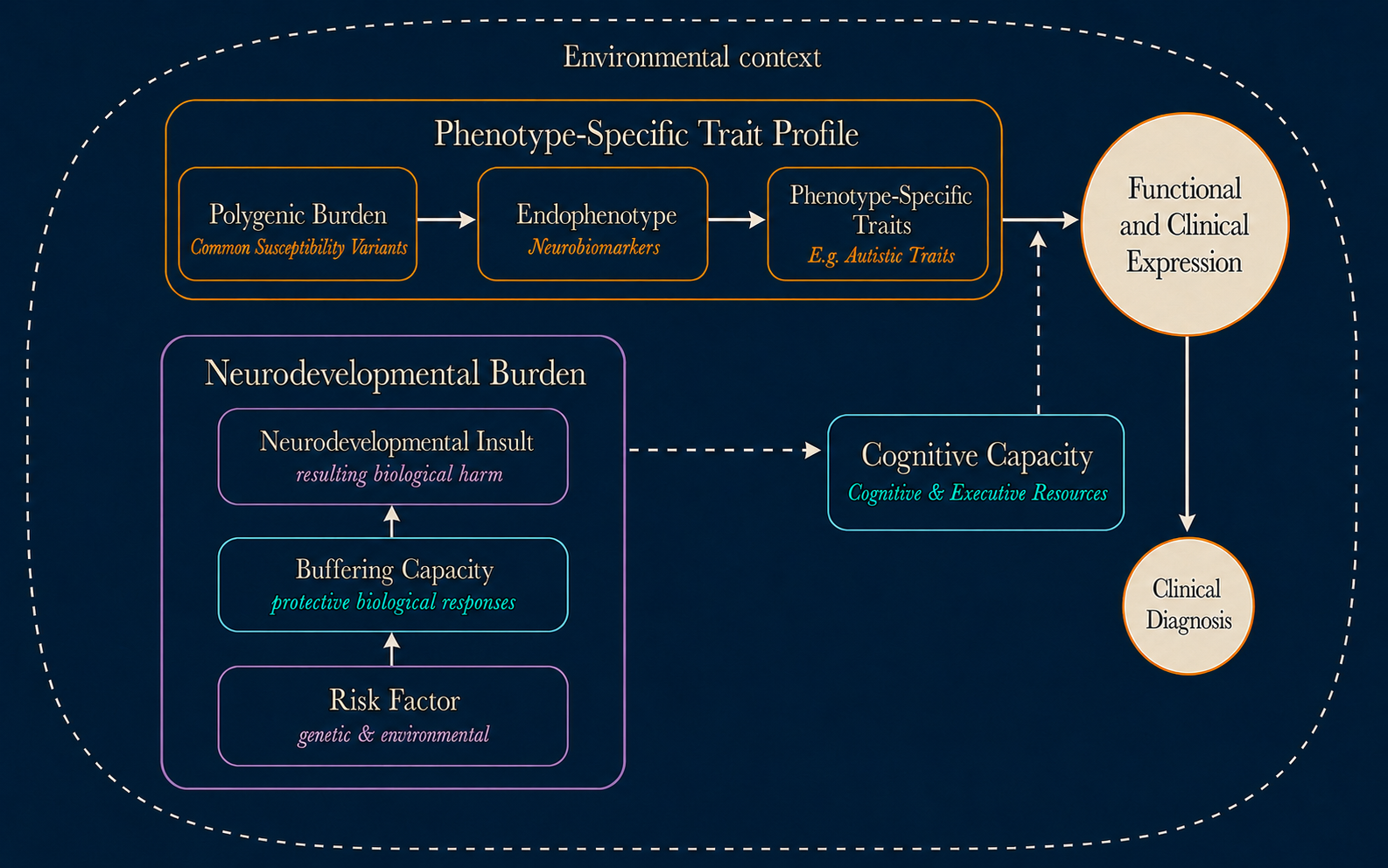
Full Pathogenetic Triad model. Common susceptibility variants contribute through a phenotype-specific neuroendophenotype to phenotype-specific traits. Risk factors are buffered before becoming neurodevelopmental insults and cumulative Neurodevelopmental Burden. Burden constrains Cognitive Capacity. Trait profile and Cognitive Capacity contribute to Functional and Clinical Expression, which may lead to Clinical Diagnosis, within environmental context.
Canonical model v1.0 · adopted July 30, 2026. The full figure shows the principal internal relations and the surrounding environmental context. Clinical Diagnosis is represented as a downstream classification of Functional and Clinical Expression.
01

Phenotype-specific trait profile

Specifies the condition-related type and pattern of neurodevelopmental traits being expressed – for example, an autistic trait profile in relation to autism or an ADHD-related trait profile in relation to ADHD.

A phenotype-specific trait profile is a partly heritable, developmentally expressed, and continuously distributed configuration of neurodevelopmental traits that supplies the phenotype-related form and overall magnitude of expression. It confers graded liability for its corresponding phenotype; it does not by itself establish impairment, support need, or diagnosis.

02

Cognitive Capacity

Represents the cognitive and executive resources available for learning, flexible responding, self-regulation, adaptation, and compensation.

Cognitive Capacity is the relatively stable but developmentally modifiable set of cognitive and executive resources that supports learning, flexible responding, self-regulation, and the management of trait- and context-related demands.

03

Neurodevelopmental Burden

Represents the cumulative developmental constraint arising across all realized insults over development after buffering and amplification.

Neurodevelopmental Burden is the latent cumulative developmental constraint arising across all realized neurodevelopmental insults over development. It reflects their net effects after biological, physiological, psychosocial, and extrinsic buffering or amplification and is hypothesized to constrain neural and regulatory development and attained or currently available Cognitive Capacity.

Six pathway families

Each relation can be studied independently or in combination.

P1–P5 describe the intrinsic causal and developmental architecture. P6 is a formally modelable downstream classification pathway. Atomic subidentifiers allow one arrow, one pathway family, or a prespecified combination to be reviewed or tested without treating the complete framework as one indivisible claim.

P1

Intrinsic causal/developmental

Phenotype-formation pathway

Phenotype-specific common-variant liability → phenotype-specific neuroendophenotype → phenotype-specific traits

The pathway formalizes how phenotype-specific liability is hypothesized to contribute to intermediate biological and cognitive features and then to the traits that constitute the relevant profile. The neuroendophenotype and each resulting trait are subfeatures within the profile, not the complete profile itself.

Atomic relations

  • P1a · Phenotype-specific common-variant liability → phenotype-specific neuroendophenotype
  • P1b · Phenotype-specific neuroendophenotype → phenotype-specific traits
P2

Intrinsic causal/developmental

Burden-formation pathway

Risk factors or exposures → buffering or amplification → realized neurodevelopmental insults → cumulative Neurodevelopmental Burden

Potential risk factors and exposures become neurodevelopmentally relevant only insofar as, after buffering or amplification, they produce realized insults. Neurodevelopmental Burden is the cumulative developmental burden arising from all realized insults across development, not a simple count of exposures.

Atomic relations

  • P2a · Risk factor or exposure × buffering or amplification → realized neurodevelopmental insult
  • P2b · Realized neurodevelopmental insults across development → cumulative Neurodevelopmental Burden
  • P2c · Insult type, timing, duration, target, and interaction → composition of Neurodevelopmental Burden
P3

Intrinsic causal/developmental

Burden–capacity pathway

Neurodevelopmental Burden → attained and/or currently available Cognitive Capacity

The principal modeled route from burden to expression is through constraint on the cognitive and executive resources attained across development or available at the relevant time.

Atomic relations

  • P3a · Cumulative Neurodevelopmental Burden → attained and/or currently available Cognitive Capacity
  • P3b · Individual realized neurodevelopmental insult → attained and/or currently available Cognitive Capacity
P4

Intrinsic causal/developmental

Compensation pathway

Cognitive Capacity and external resources → compensatory deployment → modified function and observable expression, potentially with effort and cost

Resources do not compensate merely by existing. Their deployment may improve function, reduce visible trait expression, or both, while also producing effort, short-term cost, or longer-term cost.

Atomic relations

  • P4a · Internal and external resources → compensatory deployment
  • P4b · Compensatory deployment → functional effectiveness and/or reduced trait visibility
  • P4c · Compensatory deployment → effort, sustainability, and short- or long-term cost
P5

Intrinsic causal/developmental

Expression pathway

Phenotype-specific trait profile + Cognitive Capacity and compensation + Neurodevelopmental Burden + current context → Functional and Clinical Expression

Functional and Clinical Expression is the actual integrative outcome generated by the framework. The trait profile primarily supplies the form and magnitude of expressed traits. Cognitive Capacity and compensation influence how demands are managed, Neurodevelopmental Burden may constrain available capacity, and surrounding demands, support, scaffolding, and fit moderate the resulting effects.

Atomic relations

  • P5a · Phenotype-specific trait profile → form and magnitude of the expressed trait pattern
  • P5b · Cognitive Capacity and compensation → management, visibility, functional consequence, effort, and cost
  • P5c · Current demands, support, scaffolding, and fit → moderated Functional and Clinical Expression
P6

Clinical ascertainment

Clinical ascertainment pathway

Functional and Clinical Expression + diagnostic criteria + ascertainment context → Clinical Diagnosis

This downstream classification pathway formalizes how expression is translated into diagnosis under specified criteria, assessment procedures, referral and access pathways, evaluator practices, service organization, and cultural or regional conditions.

Atomic relations

  • P6a · Functional and Clinical Expression × diagnostic criteria → diagnostic eligibility
  • P6b · Referral, access, informants, instruments, evaluator practice, and service context → observed Clinical Diagnosis
Environmental distinctions

Classify environmental factors by what they do in the model.

Environment is a broad concept. An environmental factor belongs in the burden-formation pathway when its modeled role is to produce, prevent, amplify, or limit a realized neurodevelopmental insult, such as a concrete psychosocial stressor or other environmental risk factor. It belongs to the permeative contextual layer when it modifies demands, support, scaffolding, compensation, or person–environment fit without producing or modifying such an insult, such as an environmental context that changes the effects of one or more components. It belongs to ascertainment context when it affects how Functional and Clinical Expression is translated into diagnosis, such as through differences in access to neuropsychiatric assessment or local diagnostic thresholds.

The same real-world factor may have more than one role, but each role must be represented separately.

01

Burden formation

Produces or increases the probability of a realized insult

Developmental exposures and other risk factors

02

Burden context

Prevents or limits conversion into a realized insult

Timely healthcare, prevention, and other extrinsic buffering

03

Permeative context

Modifies how traits and available capacity become expressed

Fit or mismatch, scaffolding, accommodations, demands, and support

04

Clinical ascertainment

Modifies translation of expression into diagnosis

Referral access, assessment practice, criteria, and service organization

Scientific status

Explicitly testable; not yet validated.

This Research Programme gathers canonical and versioned definitions, operationalizations, models, postulates, and predictions to foster academic and clinical uptake, independent replication, and cumulative testing. “Canonical” means authoritative for this Programme version. It does not mean immutable, proven, or protected from empirical challenge.

The PT contains causal hypotheses, but it is not yet a validated causal theory. Current empirical support is preliminary and operationalization-specific.

Framework lifecycleActive working canon
Evidence statusPreliminary
Current applicationAcademic
Current releasev1.0 · founder reviewed

Scope boundaries

What the framework does not claim

Boundaries are part of the scientific content. They prevent a broad framework from being expanded after the fact to accommodate every result.

  1. 01

    Neurodivergent traits are not inherently pathological.

  2. 02

    No single score fully measures any of the three latent components.

  3. 03

    Diagnosis is not equivalent to trait magnitude, functional impact, distress, compensatory cost, or support need.

  4. 04

    The framework does not assume one universal formula or weighting across people, outcomes, or developmental periods.

  5. 05

    The same real-world environmental factor may occupy more than one causal role, but each role must be represented separately.

  6. 06

    No direct Neurodevelopmental Burden → Functional and Clinical Expression or Neurodevelopmental Burden → phenotype-specific trait path is asserted in the current canonical figure.

  7. 07

    The PT is not ready for individual diagnosis, prognosis, or treatment selection.