An open scientific framework

A testable framework for neurodevelopmental liability and clinical expression.

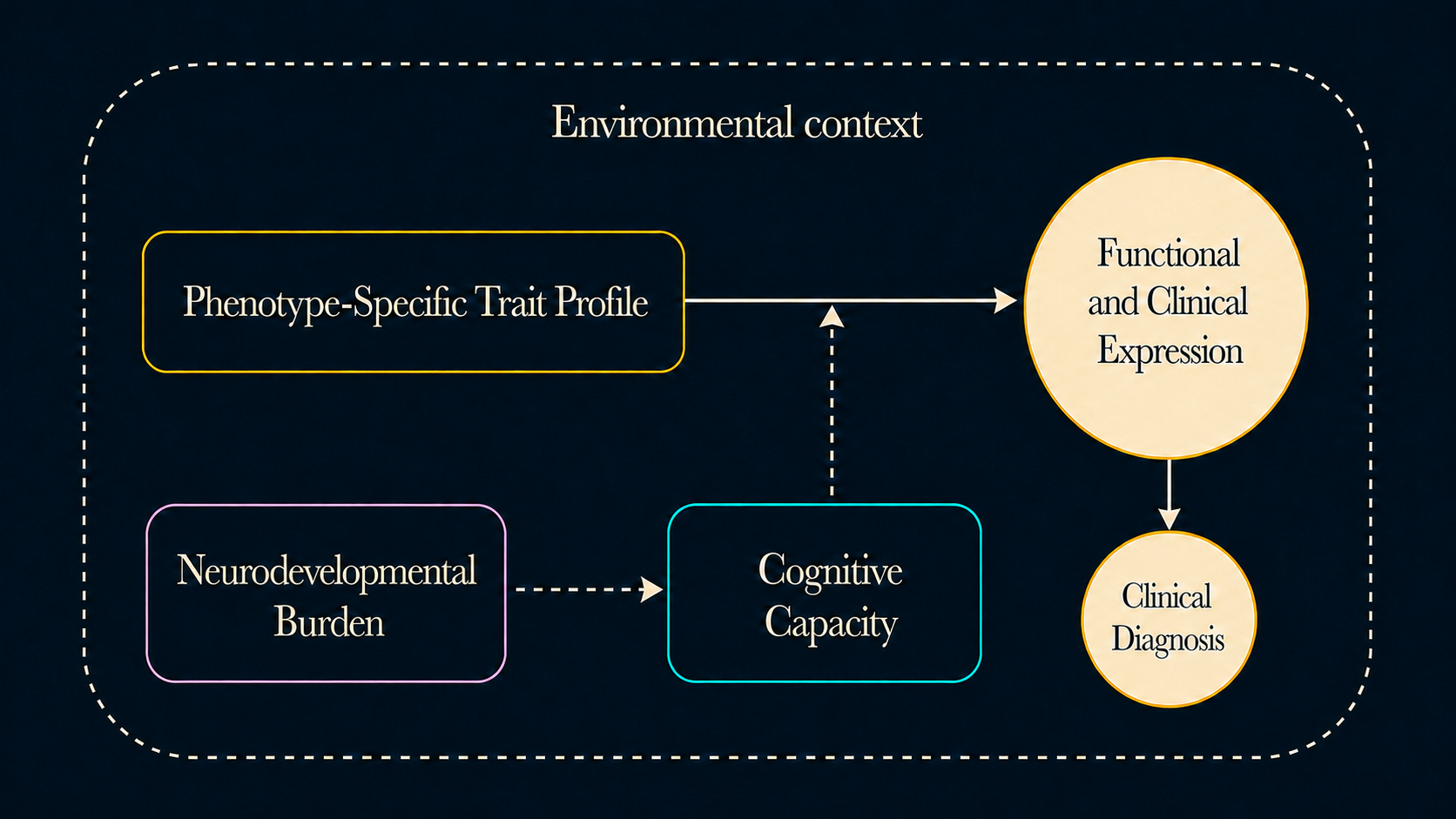
The PT is a developing multilevel, configurational liability framework. It specifies three latent domains – phenotype-specific trait profile, Cognitive Capacity, and Neurodevelopmental Burden – and proposes that their joint configuration within time-varying environmental context generates Functional and Clinical Expression. Clinical Diagnosis is a distinct downstream classification. The domains have preliminary operationalizations, making the PT a testable framework rather than only a theoretical model.

Canonical release v1.0Adopted July 30, 2026Evidence: preliminaryCurrent application: Academic
Simplified Pathogenetic Triad model. A phenotype-specific trait profile contributes to Functional and Clinical Expression. Neurodevelopmental Burden constrains Cognitive Capacity, which modifies the expression pathway. Functional and Clinical Expression may lead to Clinical Diagnosis, and the complete model operates within environmental context.

The programme archive

Explore the current public foundation

The central proposition

Disposition, resources, burden, and context are related – but not interchangeable.

The framework separates a A phenotype-specific trait profile is a partly heritable, developmentally expressed, and continuously distributed configuration of neurodevelopmental traits that supplies the phenotype-related form and overall magnitude of expression. It confers graded liability for its corresponding phenotype; it does not by itself establish impairment, support need, or diagnosis.Read the complete record, Cognitive Capacity is the relatively stable but developmentally modifiable set of cognitive and executive resources that supports learning, flexible responding, self-regulation, and the management of trait- and context-related demands.Read the complete record, and Neurodevelopmental Burden is the latent cumulative developmental constraint arising across all realized neurodevelopmental insults over development. It reflects their net effects after biological, physiological, psychosocial, and extrinsic buffering or amplification and is hypothesized to constrain neural and regulatory development and attained or currently available Cognitive Capacity.Read the complete record. Their configuration unfolds within Environmental context is the time-varying configuration of surrounding demands, supports, scaffolding, accommodations, and person–environment fit that modifies how phenotype-specific traits, available Cognitive Capacity, and compensation become functionally and clinically expressed.Read the complete record, generating Functional and Clinical Expression is a high-level, integrative concept describing what becomes observable, functionally relevant, or clinically salient when the phenotype-specific trait profile, Cognitive Capacity and its compensatory deployment, Neurodevelopmental Burden, and environment interact. It includes the expressed trait pattern and may also include context-dependent strengths and difficulties, everyday functioning, distress, compensatory effort and cost, and support need. Clinical Diagnosis is a distinct downstream classification of this expression, not part of the expression itself. Each study must specify the particular expression outcome or outcomes it measures.Read the complete record before any downstream Clinical Diagnosis is a categorical classification assigned when a person’s Functional and Clinical Expression is evaluated against specified diagnostic criteria within a particular ascertainment context.Read the complete record.

I

Traits are not impairment

A phenotype-specific trait profile may be advantageous in some contexts and disadvantageous in others, but does not by itself determine distress, diagnosis, support need, or functional impact. The underlying traits are conceived as naturally occurring and continuously distributed, not inherently pathological.

II

Resources are not performance

Cognitive resources can support adaptation, but current performance also reflects demand, compensatory deployment, effort, developmental burden, health, and the environment.

III

Exposure is not realized burden

A biological or psychosocial exposure may constrain development of cognitive resources, but timing, susceptibility, and biological, physiological, psychosocial, and extrinsic buffering influence whether it produces a lasting developmental insult.

Why this research now?

Neurodevelopmental science needs claims that can be traced, tested, and changed.

The same diagnosis can encompass markedly different trait profiles, resources, developmental pathways, compensation, and contexts. Treating these as one undifferentiated entity can obscure mechanism and contribute to heterogeneity across the scientific literature.

The Programme is converting the Pathogenetic Triad from a sequence of publications into a versioned scientific system that enables reproducibility and cumulative testing: explicit definitions, atomic pathways, bounded claims, operationalizations, explanations, and evidence records that can be independently evaluated.

Scientific status

A developing framework, not a finished causal theory.

The PT contains explicit causal hypotheses, but its current empirical support is preliminary and operationalization-specific. It is not ready for individual diagnosis, prognosis, or treatment selection.

Read the status and scope boundaries